

Do You Need Dental X-Rays at Every Visit?
Dental X-rays are a common part of dental care, but many patients wonder how often they are truly needed. If you are visiting a new dentist, returning after several years, or scheduling a routine cleaning, it is fair to ask why X-rays are being recommended and what they help your dentist see.
The simple answer is that dental X-rays are not automatically needed at every visit for every patient. Instead, your dentist should recommend imaging based on your oral health, symptoms, dental history, risk factors, and the type of care being planned.
For patients in Hayden, Coeur d’Alene, Rathdrum, Post Falls, and the surrounding North Idaho area, understanding the purpose of dental X-rays can help you feel more confident and informed during your next appointment.
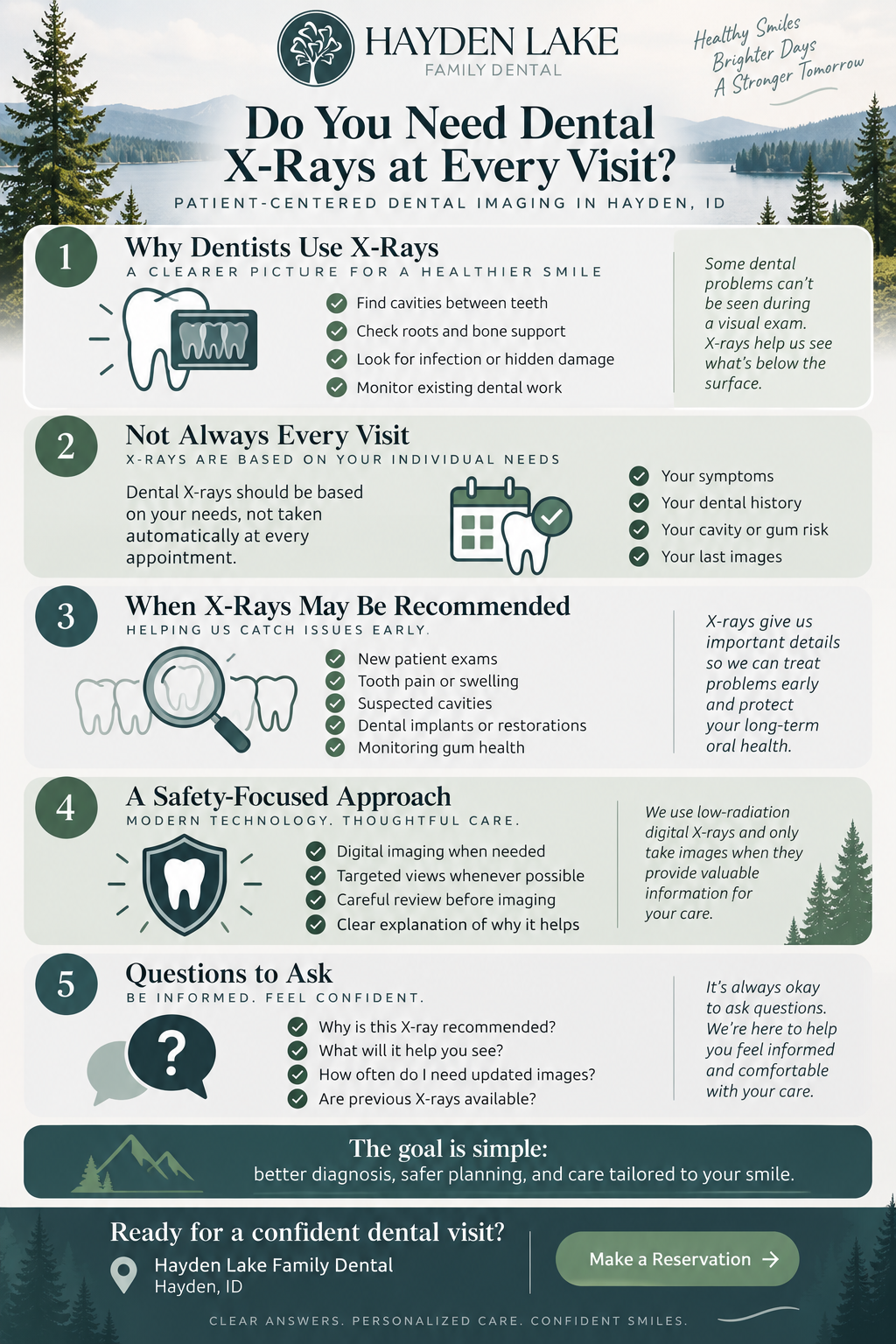
Why Dentists Use Dental X-Rays
A visual exam can show your dentist a lot, but it cannot reveal everything. Some dental problems develop below the surface or between teeth where they are difficult to see with the naked eye.
Dental X-rays can help your dentist evaluate:
Cavities between teeth
Tooth roots
Bone support
Dental infections
Impacted teeth
Cracks or hidden damage
Changes beneath crowns or fillings
Jawbone health
Areas of concern before treatment
This information helps your dentist diagnose issues earlier and create a more accurate treatment plan.
Are X-Rays Needed at Every Dental Appointment?
Not necessarily. Some patients need dental X-rays more often than others, while some may not need updated images at every routine visit.
Your dentist may consider several factors before recommending X-rays, including:
Your age
Your oral health history
Your cavity risk
Your gum health
Whether you have symptoms
Your last set of X-rays
Existing dental work
Whether treatment is being planned
Any changes since your last exam
For example, a patient with recent tooth pain, a history of frequent cavities, or a planned dental implant may need imaging sooner than a patient with stable oral health and no symptoms.
Why New Patients Often Need X-Rays
If you are visiting a dental office for the first time, your dentist may recommend X-rays to establish a baseline. This helps the dental team understand your current oral health and identify concerns that may not be visible during the exam.
New patient X-rays may help evaluate:
Existing fillings or crowns
Areas of decay
Bone levels
Wisdom teeth
Tooth root health
Previous dental work
Signs of infection
Bite alignment
Missing or impacted teeth
If you have recent X-rays from another dental office, you can ask whether those images can be transferred. In some cases, recent diagnostic images may help your new dental team avoid taking unnecessary duplicate images.
When X-Rays May Be Recommended
Dental X-rays may be recommended when your dentist needs more information to diagnose or monitor a concern.
Common reasons include:
Tooth pain
Swelling
Suspected cavities
Gum disease concerns
Dental trauma
A broken or cracked tooth
Planning a crown or bridge
Planning dental implants
Root canal evaluation
Tooth extraction planning
Monitoring children’s dental development
Checking wisdom teeth
If your dentist recommends imaging, it is appropriate to ask what they are looking for and how the X-ray will help guide your care.
What If You Have No Pain?
Pain is not the only reason dental imaging may be helpful. Some cavities, infections, bone changes, or impacted teeth may not cause symptoms right away.
By the time dental pain appears, the issue may already be more advanced. X-rays can help identify certain concerns earlier, giving your dentist more options for conservative treatment.
That said, X-rays should still be recommended based on clinical need. If you have no symptoms and your oral health has been stable, your dentist may decide that updated images are not needed at that visit.
Different Types of Dental X-Rays
Not all dental X-rays are the same. Different images are used for different purposes.
Bitewing X-Rays
Bitewing X-rays are commonly used to check for cavities between the back teeth and evaluate bone levels around the teeth.
Periapical X-Rays
Periapical X-rays show the full tooth, including the root and surrounding bone. These may be used when a specific tooth hurts or when infection is suspected.
Panoramic X-Rays
A panoramic X-ray captures a broad view of the mouth, jaw, teeth, and surrounding structures. It may be used to evaluate wisdom teeth, jaw concerns, missing teeth, or treatment planning.
3D Imaging
Some dental cases may require more advanced imaging, especially for implant planning, complex extractions, or certain surgical procedures.
Your dentist can explain which type of image is being recommended and why it is useful for your situation.
Are Dental X-Rays Safe?
Dental X-rays use low levels of radiation, and modern dental offices use safety-focused techniques to limit exposure. The goal is to capture the necessary diagnostic information while avoiding unnecessary imaging.
A thoughtful approach to dental X-rays includes:
Taking images only when needed
Using the appropriate type of X-ray
Reviewing previous images when available
Using digital imaging technology
Considering each patient’s age and risk factors
Explaining why imaging is recommended
If you have concerns about radiation exposure, pregnancy, past imaging, or medical history, bring those questions up with your dental team before the X-rays are taken.
Why Your Dental History Matters
Your dental history helps your dentist decide whether X-rays are needed. A patient with a long history of cavities, gum disease, dental implants, root canals, or extensive restorative work may need more frequent monitoring than someone with minimal past dental concerns.
Your dentist may ask about:
Past cavities
Previous root canals
Crowns or bridges
Dental implants
Gum disease treatment
Tooth extractions
Orthodontic treatment
Jaw pain or TMJ concerns
Recent dental pain
Changes in bite or chewing
The more complete your dental history is, the better your dentist can personalize your care.
Why Medical History Can Also Affect Imaging Decisions
Your medical history can also influence your oral health and treatment planning. Certain conditions and medications may affect cavity risk, gum health, healing, dry mouth, or infection risk.
Your dentist may consider your medical history when deciding whether imaging would help evaluate your oral health more completely.
This is one reason it is important to keep your medical history updated at every dental visit. Even changes that seem unrelated to your teeth may be helpful for your dental team to know.
X-Rays and Children’s Dental Visits
Children may need dental X-rays for different reasons than adults. Imaging can help dentists monitor tooth development, check for cavities between teeth, evaluate spacing, and see whether permanent teeth are developing properly.
However, children should not automatically receive X-rays at every visit either. Imaging decisions should be based on the child’s age, development, cavity risk, symptoms, and what the dentist can see during the exam.
Parents are always welcome to ask why an X-ray is being recommended and what information it will provide.
X-Rays and Emergency Dental Care
Dental X-rays are often important during emergency visits because they help the dentist identify the source of pain or damage.
If you are experiencing tooth pain, swelling, a broken tooth, or a lost filling, an X-ray may help determine whether the issue involves decay, infection, fracture, or damage below the gumline.
This can help your dentist recommend the right next step, whether that is a filling, crown, root canal, extraction, or another treatment option.
X-Rays and Restorative Dentistry
If you are planning restorative dental care, X-rays may be part of the evaluation process. Treatments such as crowns, bridges, dental implants, dentures, root canals, and extractions often require a clear understanding of the tooth roots, jawbone, and surrounding structures.
Imaging helps your dentist plan treatment more accurately and avoid surprises during care.
For patients replacing missing teeth, X-rays may also help determine whether there is enough bone support for certain options, including dental implants or implant-supported dentures.
Questions to Ask Before Dental X-Rays
If you are unsure why X-rays are being recommended, it is okay to ask. A good dental team should be willing to explain the purpose of imaging and how it supports your care.
Helpful questions include:
Why are X-rays recommended today?
What are you looking for with these images?
When were my last dental X-rays taken?
Can previous X-rays be transferred from my last dentist?
Are these images needed for diagnosis or treatment planning?
What type of X-ray is being taken?
How often do I personally need updated images?
These questions can help you feel more informed and involved in your care.
A Personalized Approach to Dental X-Rays in Hayden, ID
Dental X-rays are an important tool, but they should be used thoughtfully. The goal is not to take images automatically. The goal is to gather the right information at the right time so your dentist can protect your oral health and recommend care with confidence.
At Hayden Lake Family Dental, patients in Hayden and the surrounding North Idaho area receive personalized dental care focused on comfort, clarity, and long-term health. Whether you are scheduling a routine exam, visiting as a new patient, or dealing with tooth pain, your dental team can explain when X-rays may be helpful and why they are being recommended.
If you have questions about dental X-rays, routine exams, or your next visit, schedule an appointment with Hayden Lake Family Dental in Hayden, ID.
Frequently Asked Questions Around Dental X-Rays
-
Not always. Dental X-rays should be recommended based on your symptoms, oral health history, cavity risk, gum health, previous images, and treatment needs. Some patients need them more often than others.
-
Some dental problems do not cause pain right away. X-rays can help detect cavities between teeth, infections, bone changes, impacted teeth, and other concerns that may not be visible during a regular exam.
-
Yes. It is completely appropriate to ask why X-rays are being recommended, what they will help your dentist see, and whether recent images from another dental office can be used.
-
Dental X-rays use low levels of radiation, and modern dental offices use techniques designed to limit exposure. Your dentist should recommend imaging only when it provides helpful diagnostic or treatment-planning information.
